
Advertising
The Tasmanian Government undertakes advertising to:
- promote government policies, programs and services
- promote engagement opportunities
- inform the public of their rights, obligations and entitlements.
Procurement of services must be carried out in line with the Treasurer’s Instructions (TIs) and relevant agency processes.
When planning advertising, it is important to take into consideration:
- the relevance, accuracy and objectivity of the type and content of advertisement
- accessibility, compliance and accountability
- value for money.
Advertising types
Campaign advertising
Designed to reach a target audience to make it aware of government activities or programs that may impact or engage it, or that the audience can engage with. This type of advertising includes, but is not limited to:
- a full or partial advertising campaign using multiple tools
- single channel advertising such as print advertisements in newspapers.
Non-campaign advertising
Routine advertising carried out by agencies relating to their operational activities. This may include, but is not limited to:
- recruitment, employment, educational courses and enrolments
- auctions and tenders
- grants (including emergency funding)
- announcements, surveys, public and statutory notices
- emergency notices.
Advertising requirements
When planning and procuring advertising, in addition to complying with the Tasmanian Government Corporate Brand Identity and Communications Policy, agencies must comply with the Tasmanian Government's buying for government processes.
Various types of advertising also have individual policy requirements. Regardless of the type of advertising, accessibility, copyright, intellectual property and procurement guidelines must be followed.
All government advertising must be readily identifiable by the target audience as coming from the Tasmanian Government.
Exemptions
In special circumstances exemptions may apply. These should be discussed with your agency’s communications manager. Examples where an exemption may apply include:
- where there is a recognised need for a display advertisement to be placed in the early general news (EGN) or other non-classified section of newspapers or other publications to target specific audiences
- advertisements that market educational courses
- where an agency wishes to run routine government advertising outside the consolidated format
- selected platforms where policy requirements won't deliver optimal results.
Commercials and videos relating to government programs
This includes television commercials, commercials or educational videos on platforms such as YouTube. Go to the Toolbox for more information.
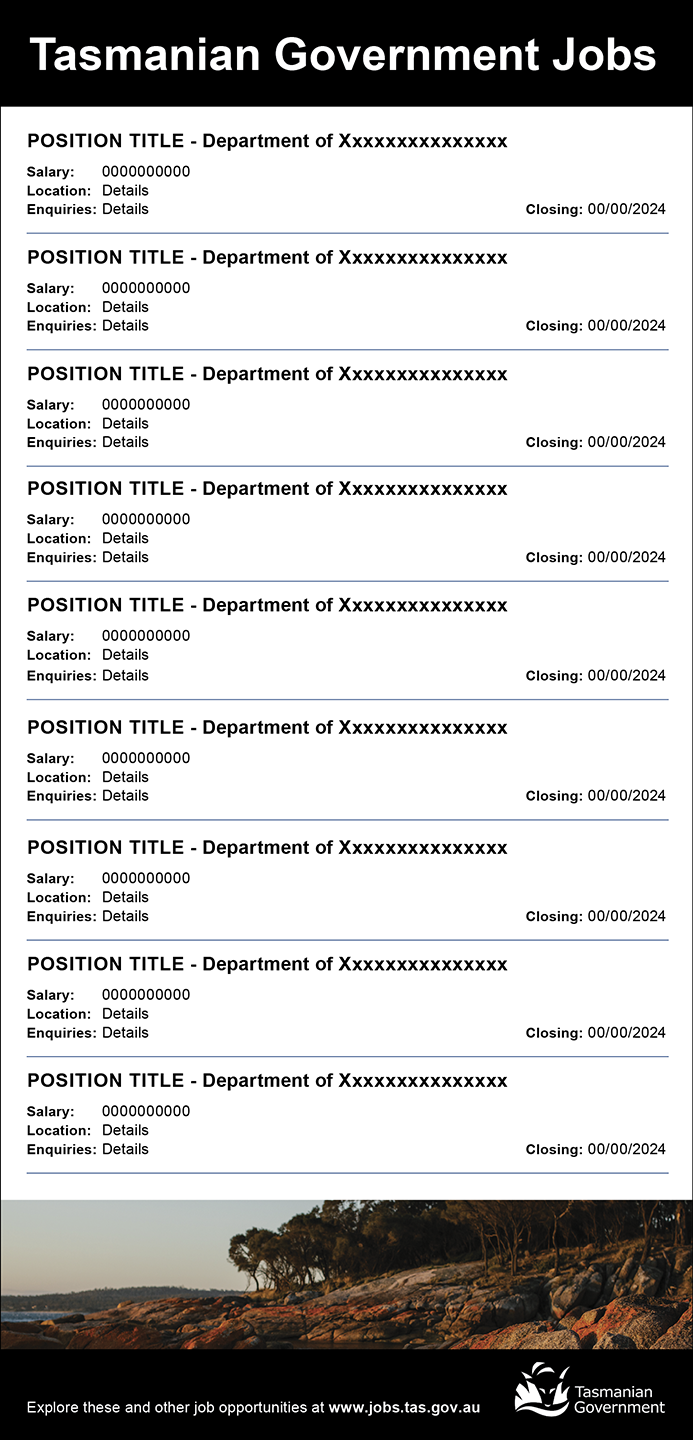
Advertisements promoting employment opportunities, tenders and public notices
For print advertisements of employment opportunities, tenders and public notices, agencies must:
- put in as a consolidated format in Tasmanian papers and, where appropriate, in interstate and overseas newspapers or journals
- advertise under a whole-of-government banner. As the Tasmanian Government logo is already featured in the footer, individual advertisements do not need to include the logo. Font must be Arial
- non-campaign advertising is booked through Gray Matters Advertising.
Mandatory elements
- Logo
- Font
Advertisements promoting programs and engagement opportunities
For press and digital advertisements promoting programs and engagement opportunities, agencies must comply with the requirements of the Tasmanian Government Corporate Brand Identity and Communications Policy on specific platforms, including but not limited to:
- print advertising in newspapers, magazines or other printed publications, including content partnerships
- digital advertising in online editions of newspapers, magazines or other digital publications, including content partnerships
- social media advertising, including paid content partnerships, content plans and schedules
- display advertising
- search engine marketing – per click and search engine optimisation (SEO)
- video advertisements
- email marketing campaigns.
For print advertising in newspapers, the early general news (EGN) refers to the front section of the newspaper in which the main news stories are located.
Any print advertisements placed in the EGN section need to incorporate the:
- Tasmanian Government logo
- Tasmanian Government font unless otherwise approved
- The logo may not be any smaller than the minimum size requirement (20mm for the vertical version and 30mm for the horizontal version).
Outdoor advertising
Outdoor advertising includes billboards and advertisements on buses (bus backs) and taxis (taxi backs).
The Tasmanian Government logo must be clearly visible on all outdoor advertising. The size of the logo on outdoor advertising should be guided by the ratios outlined below to ensure that the Tasmanian Government logo is prominent and clearly visible at a reasonable distance.
- Billboards: The logo has a minimum size of 520mm wide, based on an average 24-sheet billboard, that is 3m high and 6m wide.
- Bus backs: The logo must be a minimum size of 285mm, based on average dimensions of 2100mm high and 2100mm wide.
- Taxi backs: The logo must be a minimum size of 70mm wide, based on the average dimensions of 400mm high and 800mm wide.
Selling or accepting advertising
From time to time, advertising opportunities are made available by external parties, or government may facilitate publications where brand aligned, or industry partners have the opportunity to advertise.
This type of activity often falls under a "sponsorship" or "partnership" style arrangement.
If you are considering this type of activity, first consult with your agency’s communications manager.
Advertising approval process
Before undertaking any advertising, including across the board campaigns to one-off advertisements to help create awareness of government projects, programs and opportunities you must:
- complete a project plan and supporting communications plan that identifies how you aim to create awareness of the activity – including proposed advertising channels
- establish a budget and have the budget approved
- ensure you meet Treasurer’s Instructions if required
- contact your agency’s communications manager and procurement manager for advice and input about the proposed activities and to review the creative brief and request for quote (RFQ)
- throughout the development of campaigns and new departmental brands, collaborate with your agency’s communications team and subsequently the communications team in the Department of Premier and Cabinet.